
Description
The flashing for windows that have no flange
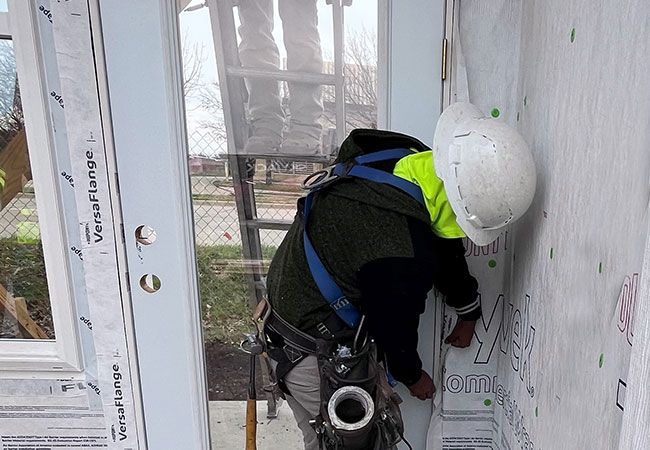
Most window flashing assumes a nailing flange. You lap the tape over the flange, onto the sheathing, and the geometry does the rest. But a brick mold window, a non-flanged unit, or a PTAC sleeve gives you nothing to lap onto — the frame just sits in the opening.
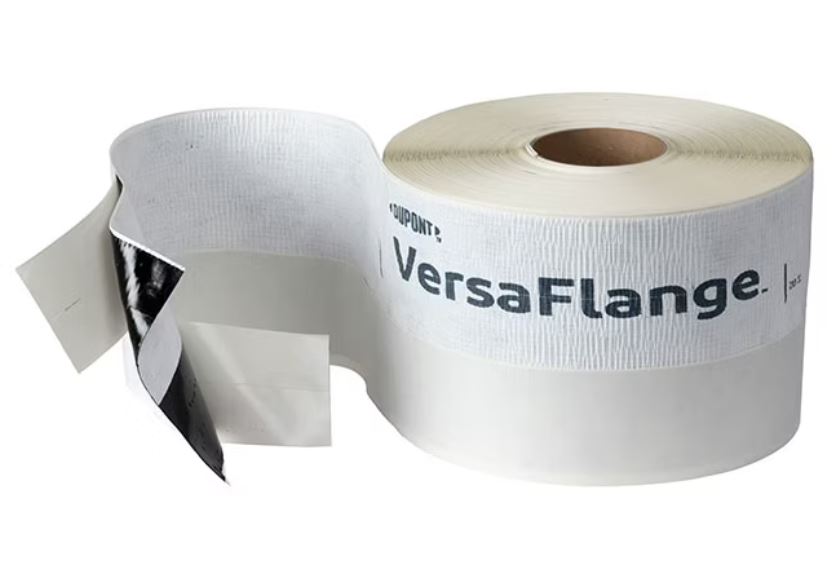
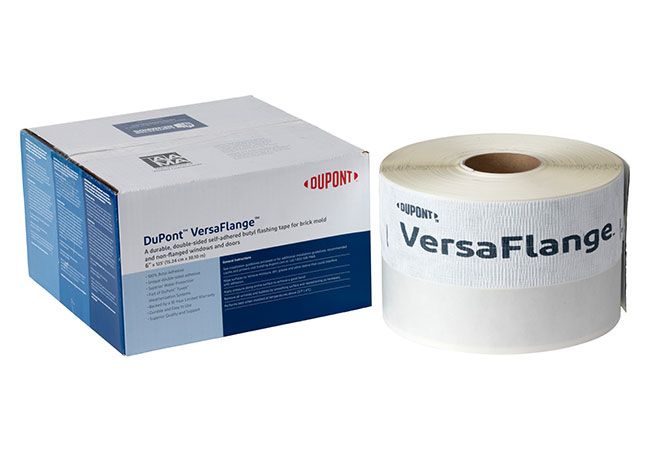
DuPont™ VersaFlange™ solves that with butyl adhesive on both faces. One side takes the window or door frame, the other takes the sheathing or the water-resistive barrier, and the flashing becomes the bridge between them. That is a different product from everything else on this page, not a different width of the same thing.
If you know this product as Tyvek® StraightFlash™ VF, that is the same roll. DuPont renamed it VersaFlange.
Flanged, non-flanged, or a sill pan — which one you need
| Your opening | What it needs |
| Brick mold or non-flanged window or door | VersaFlange (this roll) — double-sided, ties the frame to the wall |
| Window with a nailing flange | DuPont Flashing Tape — single-sided, laps over the flange |
| Sill pan, curve, or arched head | DuPont FlexWrap NF — stretches into corners |
| Housewrap seams | Tyvek Sheathing Tape — seams only, not flashing |
Crews doing a mixed job carry two of these. The flanged units get the single-sided tape; the brick mold and the patio doors get this.
What the scored liner buys you
Double-sided adhesive is harder to place than single-sided — you cannot slide it once both faces are exposed. The answer DuPont built in is a scored release liner: you peel one section, set the flashing against the frame, and only then release the rest onto the wall.
The initial tack is deliberately forgiving. DuPont describes it as allowing you to reposition and correct installation mistakes, which on a double-sided product is the difference between a clean job and a ruined piece.
No asphalt — and that is not a detail
VersaFlange carries no asphaltic or bitumen adhesive. The top sheet is micro-creped DuPont™ Tyvek® over 100% butyl.
That matters because many window manufacturers prohibit asphalt-based flashings against their product. DuPont names the reasons directly: black staining, oozing, and deformation over time — particularly against vinyl flanges. If the window warranty says no bitumen, an asphalt tape can cost you the warranty on a unit worth far more than the roll.
Specifications
| Type | Self-adhered flashing, double-sided butyl |
| Top sheet | Micro-creped DuPont™ Tyvek® |
| Adhesive | 100% butyl — no asphalt, no bitumen |
| Release liner | Scored, for staged placement |
| Size | 6 in × 125 ft (1 roll) |
| Application temperature | Down to 25°F (-4°C) on clean, frost-free surfaces |
| UV exposure limit | 9 months (270 days) |
| AAMA 711 | Class A (no primer), Level 3 thermal exposure (176°F for 7 days) |
| Air leakage (ASTM E1677) | < 0.04 cfm/ft² assembly |
| Water penetration (ASTM E331) | No leakage at 300 Pa, including after thermal aging (0–120°F) |
| Vapor permeance (ASTM E96) | < 1 perm |
| Warranty | 10-year limited, installed as part of the Tyvek® WRB system |
| Factory case | 4 rolls |
| Condition | New, factory sealed |
Nine months of sun
The UV rating is the number worth circling. VersaFlange is rated for 270 days of exposure; the DuPont Flashing Tape line is rated for 120.
On a job where the windows go in early and the cladding is waiting on a trade, a brick mold opening flashed in March is still covered in December. That is a real scheduling margin, not a spec-sheet flourish.
How far 125 feet goes
Non-flanged work is perimeter work, so budget the full way around the frame plus laps at the corners:
| Opening | Per unit | Per roll |
| 2 ft 8 in × 4 ft window | ~15 ft | 8 |
| 3 ft × 5 ft window | ~18 ft | 6 |
| 3 ft entry door, jambs and head | ~18 ft | 6 |
| 6 ft patio slider, jambs and head | ~21 ft | 5 |
A 125-foot roll covers the brick mold openings on most single-family plans in one go. The factory case is 4 rolls if you are running a subdivision.
Where it must not go
DuPont is specific about the limits, and these are the ones that generate callbacks:
- Not for through-wall flashing. VersaFlange is a window and door product. Through-wall details need a product listed for them
- Do not install over cap fasteners. The flashing needs a flat plane to seal against
- Concrete, masonry, and glass mat exterior gypsum sheathing require a compatible primer. On ordinary wood sheathing and housewrap, no primer is needed — that is what Class A means
- The rough sill must be level or sloped slightly to the exterior so water drains out, not in
Installation notes
You need:
- A clean, dry surface free of frost, ice, dirt and grease
- Surface and air at 25°F or above
- A J-roller or firm hand pressure along the entire surface — this is not optional on a double-sided product
- Primer where the substrate calls for it (concrete, masonry, glass mat gypsum)
- Patience with wrinkles and bubbles: smooth them out and reposition before you commit the second face
The release paper is slippery — get it out of the work area rather than leaving it underfoot on a deck or a staging plank.
Contractor and volume pricing
Flashing brick mold or non-flanged units across a job? Call (832) 463-7946 or email sales@85builders.com with your quantity and the job-site ZIP code and we will send pricing the same business day. The factory case is 4 rolls.
We accept Texas resale certificates for tax-exempt purchases.
Frequently asked questions
Is this the same as StraightFlash VF?
Yes. DuPont renamed StraightFlash™ VF to VersaFlange™. Same roll, same 6 in × 125 ft, same double-sided butyl.
What makes it different from regular DuPont Flashing Tape?
Two faces instead of one. Flashing Tape laps over a nailing flange onto the wall. VersaFlange bonds the frame itself to the wall, which is the only way to do it when there is no flange to lap.
Can I use it on a window that does have a flange?
You can, and DuPont lists non-integral flanged units among its applications. But if the flange is there and integral, single-sided tape is cheaper per foot and faster.
Does it come in other widths?
No. DuPont publishes one standard size for VersaFlange: 6 in × 125 ft. If you see a 9-inch listing under this name, check it carefully — it is probably standard StraightFlash.
How cold can I install it?
Down to 25°F, on a surface that is clean and free of frost and ice. Below that, warm the substrate or wait.
Do I need primer?
Not on common wood sheathing or housewrap — it is AAMA 711 Class A, which is the no-primer classification. Concrete, masonry and glass mat exterior gypsum do require a compatible primer.
How long can it stay exposed?
Nine months. That is 270 days, against 120 for the standard flashing tapes.
How fast does it ship?
We ship next business day from Cypress, TX.


Reviews
There are no reviews yet.